Affiliate Disclosure: This post contains affiliate links. If you make a purchase through these links, I receive a commission at no additional cost to you.
When planning a trip to South Korea, you may wonder whether to install an eSIM or collect a physical SIM at the airport. The answer to Korea eSIM vs SIM card is not as simple as saying that one is always better.
The right option depends on your phone, travel schedule, and whether you need a Korean phone number. Let’s compare both options using the same practical criteria, from collection and setup to data, cost, and device changes.
Table of Contents
1. What Is the Difference Between an eSIM and a Physical SIM?
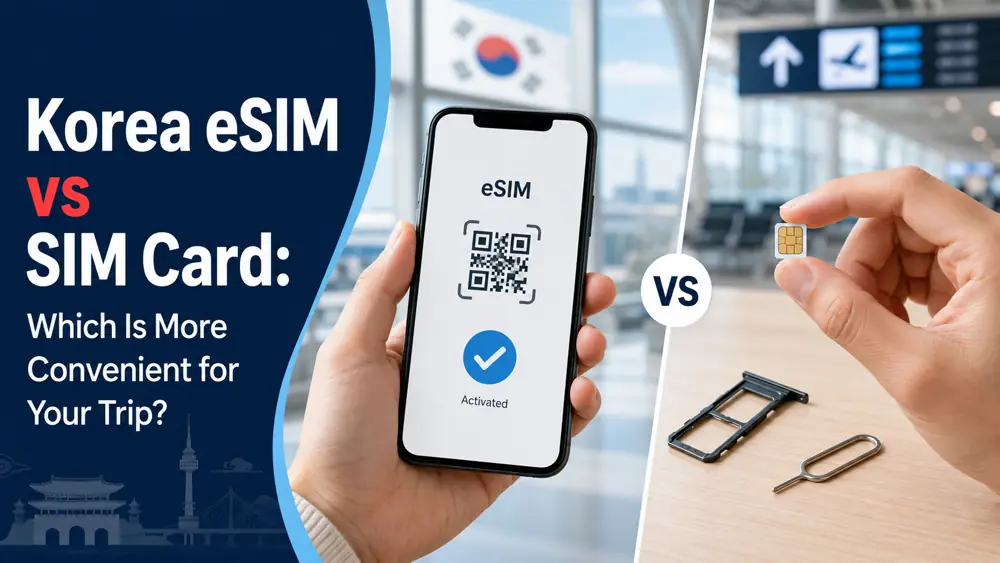
The most basic difference in Korea eSIM vs SIM card is how the mobile plan is stored on your phone. An eSIM is installed digitally on a chip already built into the device, while a physical SIM is a removable plastic card inserted into the SIM tray.
| Feature | eSIM | Physical SIM |
|---|---|---|
| Format | Digital SIM built into the phone | Removable SIM card |
| Setup | App, QR code, or activation code | Inserted into the SIM tray |
| Home SIM | Can usually remain in the phone | May need to be removed and stored |
| Delivery | Available online | Airport collection, store visit, or delivery |
| Compatibility | Requires an eSIM-compatible phone | Requires a compatible SIM slot |
| Moving to another phone | May require reissuing the plan | Can be moved to a compatible phone |
An eSIM is convenient because you can add a travel-data line without removing your regular SIM. A physical SIM can be used on phones that do not support eSIM, provided the device is unlocked and compatible with Korean mobile networks.
Connection quality depends more on the local carrier, plan conditions, and network coverage than on the SIM format. If both products use the same network, the eSIM is not automatically faster or slower than the physical SIM.
2. Which Is Easier to Buy and Receive?
When comparing convenience in Korea eSIM vs SIM card, the biggest difference is usually online delivery versus airport collection. An eSIM can be delivered through an app or email, so you do not need to visit a counter after landing.
| Travel situation | More convenient option |
|---|---|
| Arriving late at night | eSIM |
| Going directly from the airport to the city | eSIM |
| Completing setup before departure | eSIM |
| Not comfortable with phone settings | Physical SIM |
| Wanting help from airport staff | Physical SIM |
| Using a phone without eSIM support | Physical SIM |
Klook’s featured South Korea data eSIM can be installed through its app or with a QR code. Depending on the product conditions, you can prepare it before departure and connect after arriving in Korea.
Physical SIM products are often reserved online and collected from carrier counters at Incheon, Gimpo, or Gimhae Airport. You may need to present your voucher and passport or photo ID, so check the collection location and opening hours in advance.
A physical SIM may actually feel easier if airport staff insert the card and test the connection for you. However, you may need extra time to locate the counter or wait in line during busy arrival periods.
3. Which Is Easier to Set Up?
For installation, Korea eSIM vs SIM card comes down to digital settings versus physically replacing a small card. An eSIM requires a few steps in your phone’s settings, while a physical SIM requires opening the SIM tray.
| Setup detail | eSIM | Physical SIM |
|---|---|---|
| What you need | Wi-Fi and a QR code | SIM ejector tool |
| Installation | Add a mobile plan in Settings | Insert the card into the SIM tray |
| Home SIM storage | No removal required | Must be stored safely |
| Setup assistance | Usually online support | Airport staff may help |
| Common issue | Data line or roaming settings | Card recognition or network compatibility |
With an eSIM, you normally scan a QR code and then choose the correct line for mobile data. Some plans also require data roaming to be enabled after you reach South Korea.
A physical SIM is inserted after removing your existing SIM. The process is straightforward, but your original card is small and easy to lose while traveling.
Both options require an unlocked phone. A physical SIM may also fail if the device does not support the frequencies used by the Korean network.
This article focuses only on the comparison. For detailed iPhone and Samsung instructions, connect this section to the separate installation guide.
4. Do Both Options Provide a Korean Phone Number?
A common misunderstanding in Korea eSIM vs SIM card is that an eSIM is always data-only and a physical SIM always includes a Korean number. In reality, the included services depend on the plan—not on whether the SIM is digital or physical.
| Product type | Korean number and calling features |
|---|---|
| Data-only eSIM | Usually does not include a Korean number |
| eSIM with calls and texts | May include a Korean number |
| Data-only physical SIM | Regular calls and texts are unavailable |
| Physical SIM with calls and texts | May include a Korean number |
| Data plus incoming service | Incoming calls may work; outgoing calls may require a top-up |
SK Telecom offers a tourist eSIM that supports incoming calls and text messages after passport verification. Outgoing calls and texts require an additional top-up, and the number cannot be used for personal identity or payment verification.
KT also offers tourist eSIM and physical SIM products with different service types. When comparing Klook listings, look for wording such as Data only, Incoming calls/texts, or Call and SMS.
If you need to call a restaurant, accommodation, or tour operator, check whether outgoing calls are supported. Keeping your original number active through Dual SIM is also different from receiving a new Korean number.
- Voice-enabled option: SK Telecom tourist plan
5. How Do Prices and Data Plans Compare?
When considering cost in Korea eSIM vs SIM card, do not compare only the lowest price displayed on the product page. The final value depends on validity, high-speed data, reduced-speed limits, calling features, and additional top-up costs.
| Comparison | Typical data eSIM | Typical KT physical SIM |
|---|---|---|
| Validity | Commonly 1–30 days | Options may cover 1–90 days |
| Network speed | 5G or 4G LTE | Often 4G LTE |
| Service type | Mainly data-only | Data-only or calls and texts |
| Data options | Fixed, daily, or unlimited | Often unlimited-data plans |
| Hotspot sharing | Available on selected plans | Available on selected plans |
| Additional costs | Usually based on selected data | Voice and text top-ups may cost extra |
For a short trip with light data use, a 1GB, 3GB, or 5GB eSIM can be cost-effective. A physical SIM may cost more when airport collection, local-number service, or staff assistance is included.
“Unlimited” does not always mean unlimited full-speed data. Some plans reduce the speed to 1Mbps or 5Mbps after a daily high-speed allowance has been used.
Klook prices can vary by country, currency, discount, and purchase date. Instead of relying on a fixed advertised price, compare the complete cost for your travel dates and include any voice or text top-up charges.
6. What Happens If You Lose Your SIM or Change Phones?
Device changes reveal another important difference in Korea eSIM vs SIM card. An eSIM cannot be physically lost, but deleting its profile or replacing your phone can make reinstallation difficult.
| Situation | eSIM | Physical SIM |
|---|---|---|
| Risk of losing your home SIM | Low because it stays installed | Must be removed and stored |
| Risk of losing the travel SIM | No physical card to lose | Small card can be lost |
| Profile or card removal | Deleted profile may not be reusable | Card can be reinserted |
| Moving to another phone | May require reissuing the plan | Can be moved to a compatible phone |
| Phone failure | May not work immediately on a new device | Can be removed and transferred |
SK Telecom warns that if you delete a tourist eSIM profile, you may need to purchase a new plan. Klook also states that one QR code cannot be used on multiple devices.
If your eSIM is not connecting, do not delete the profile immediately. Take screenshots of the error and contact the seller before making changes.
A physical SIM is easier to move if your phone breaks and you have another unlocked, compatible device. The downside is that you must keep both the Korean SIM and your original SIM safe throughout the trip.
7. Which Option Fits Your Travel Plans?
For most travelers, Korea eSIM vs SIM card depends on phone compatibility, arrival plans, local-number needs, and comfort with phone settings—not simply the length of the trip.
| Travel situation | Recommended option |
|---|---|
| Short trip of 1–7 days | Instantly delivered eSIM |
| Going directly into the city | eSIM |
| Keeping your regular SIM installed | Dual SIM with a travel eSIM |
| Using a recent eSIM-compatible phone | eSIM |
| Using a phone without eSIM support | Physical SIM |
| Wanting airport setup assistance | Physical SIM |
| Needing a Korean number | Voice-enabled eSIM or physical SIM |
| Staying longer than 30 days | Compare extension and calling conditions |
For a short sightseeing trip focused on maps, translation, and messaging apps, a data eSIM is usually convenient. You can prepare it before departure without removing your original SIM.
A physical SIM can be easier if your phone does not support eSIM or you prefer staff to help with activation. If you need a Korean phone number, search for plans with calls and texts before deciding between digital and physical formats.
The best option depends on the features you need. Compare compatibility, collection method, local-number service, data conditions, and the possibility of changing devices before paying.
Frequently Asked Questions
Is an eSIM always better than a physical SIM in South Korea?
No. An eSIM is convenient when your phone supports it and mobile data is your main priority. A physical SIM may be easier if your device does not support eSIM or you want help from staff at an airport counter.
Is a physical SIM faster than an eSIM?
The SIM format does not determine internet speed by itself. The local carrier, plan restrictions, high-speed allowance, device compatibility, and network conditions have a greater effect.
Do I need a physical SIM to get a Korean phone number?
Not necessarily. In Korea eSIM vs SIM card, either format may include a Korean number if the selected plan supports calls and text messages. Check whether the product is data-only and whether it supports incoming and outgoing calls.
Key Takeaways
The answer to Korea eSIM vs SIM card depends on your phone and the services you need. An eSIM offers instant online delivery and allows you to keep your home SIM installed, while a physical SIM works with more devices and may include airport setup assistance. Compare data, local-number support, collection, compatibility, and device-transfer options—not just the advertised price.