Affiliate disclosure: This post contains affiliate links to Klook. If you make a booking through these links, I may earn a commission at no additional cost to you.
Wondering whether to exchange money before your trip or wait until you arrive in Korea? A smart Korea currency exchange plan considers both the quoted rate and the amount you actually receive after fees.
Airports, banks, Myeongdong exchange counters, and ATMs each offer a different balance of cost and convenience. This guide explains how to choose the right option, how much cash to carry, and how to use your cards with confidence.
1. Korean Won: A Quick Guide for Travelers
South Korea’s official currency is the won, written as KRW or ₩.
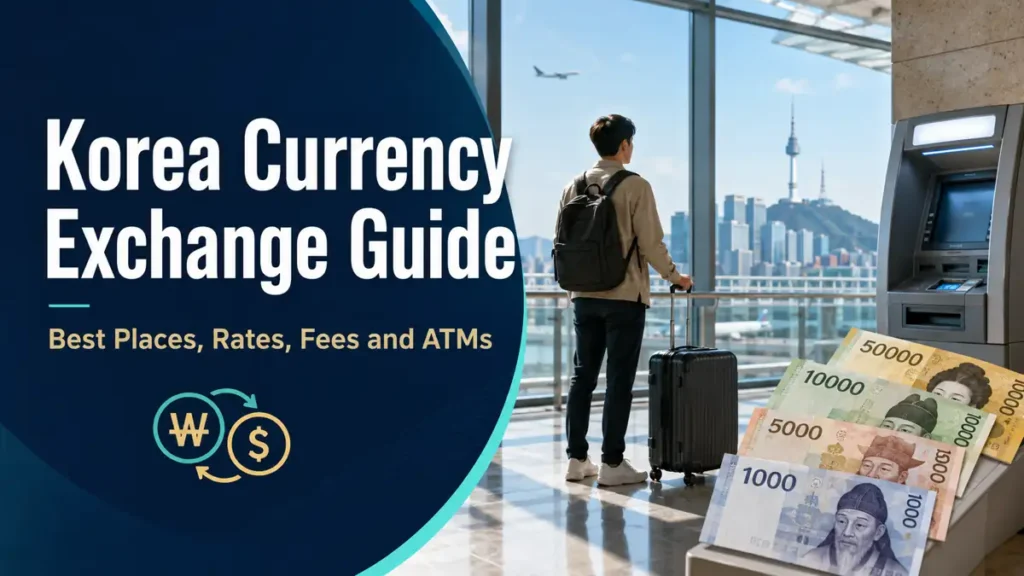
The banknotes travelers use most are ₩1,000, ₩5,000, ₩10,000, and ₩50,000, while common coins come in ₩10, ₩50, ₩100, and ₩500 denominations.
Because won prices contain more zeros than many visitors are used to, learning the colors and values of the notes can make everyday payments much easier.
| Type | Denomination | Common travel use |
|---|---|---|
| Banknote | ₩1,000 | Small purchases and transit card top-ups |
| Banknote | ₩5,000 | Snacks, cafés, and inexpensive meals |
| Banknote | ₩10,000 | Meals and shopping |
| Banknote | ₩50,000 | Larger purchases |
| Coin | ₩10, ₩50, ₩100, ₩500 | Change, vending machines, and some kiosks |
If you receive only ₩50,000 notes, getting change may be inconvenient at a small shop. Ask for a mix of ₩10,000 and ₩5,000 notes when possible.
VISITKOREA provides clear images of Korean banknotes and coins if you want to recognize them before your trip.
2. Korea Currency Exchange: Where Should You Go?
International visitors can exchange foreign cash at airport counters, downtown banks, and authorized currency exchange offices.
Banks generally open from 9:00 a.m. to 4:00 p.m. on weekdays, although hours vary by branch and location.
Bring your passport, as an exchange counter may ask for identification before completing the transaction.
| Option | Main advantage | What to check | Best for |
|---|---|---|---|
| Airport exchange counter | Available as soon as you arrive | Hours and customer exchange rate | Transport and first-day expenses |
| Downtown bank | Regulated and straightforward | Weekday hours and ID requirements | Travelers who can visit during banking hours |
| Authorized exchange office | Convenient in tourist districts | Shop-specific rate and opening hours | Additional cash during your stay |
| International-card ATM | No need to carry large amounts of foreign cash | ATM and card issuer fees | Withdrawing won as needed |
Some banks and exchange offices may reject old, damaged, or heavily marked foreign banknotes. Instead of comparing the headline rate alone, ask how much Korean won you will receive for the same amount of foreign currency.
For a small exchange, the time and transport cost of finding a slightly better rate may outweigh the savings.
3. Airport, Bank, or Myeongdong: Which Is Better?
Airport exchange is the most convenient option, but it is not automatically the best or worst choice for every currency and amount.
Incheon Airport has bank branches and exchange counters in both terminals, including some counters that operate 24 hours.
When choosing a Korea currency exchange location, consider your arrival time and travel route as well as the rate.
| Travel situation | Option to consider first | Why it may work |
|---|---|---|
| Late-night or early-morning arrival | An open airport counter or ATM | Downtown banks may be closed |
| Taking the airport train or bus | Exchange enough money at the airport | Gives you won for your first journey |
| Staying in Seoul on a weekday | Compare a downtown bank and authorized exchange office | More options are available during the day |
| Already visiting Myeongdong | Compare the final amount at licensed counters | Avoids a separate trip just to exchange money |
| Exchanging a small amount | Use a safe, convenient location | Time saved may matter more than a minor rate difference |
Locations and hours at Incheon Airport can change, so check the airport’s facilities page before departure.
Myeongdong exchange offices also set their own customer rates, so do not assume every counter offers the same deal.
A practical first-trip approach is to get enough won for your immediate needs at the airport and compare the rest later.
Want to Book Your Airport Bus Before Arrival?
If you would rather arrange your first ride before landing, Klook offers an Incheon Airport Limousine Bus ticket to several areas of Seoul.
Booking online means your airport transfer is already paid for, so you do not need to exchange cash just to buy the bus ticket after arrival.
Choose the route closest to your hotel and check the latest timetable before completing your booking.
| Booking detail | What to know |
|---|---|
| Available journeys | Incheon Airport to Seoul or round trip |
| Seoul routes | Myeongdong, Dongdaemun, City Hall, Yeouido, and other districts |
| Price shown | From ₩11,800 in the provided listing; prices and currency displays can change |
| Booking status | Instant confirmation was shown on the listing |
| Ticket redemption | Exchange the Klook voucher for a physical ticket at the airport bus ticket counter |
| Customer activity | Rated 4.7/5 with about 2.9K reviews and 100K+ bookings when checked |
| Limited promotion | A free 7-day, 1GB South Korea eSIM was offered through the app at checkout |
The eSIM offer, price, rating, and booking count were checked on July 19, 2026 and may change without notice.
The bus is most convenient when its route stops near your hotel; otherwise, the AREX train or another transfer option may be more practical.
Check the exact route, voucher redemption instructions, luggage rules, cancellation terms, and current price before paying.
▶ Check the latest price and book the Incheon Airport Limousine Bus on Klook
▶ Incheon International Airport Railway AREX one-way ticket
4. How Exchange Rates and Fees Work
The rate shown by an online converter may not be the same rate offered for physical banknotes.
If you are giving a Korean bank US dollars and receiving won, look for the bank’s foreign-cash buying rate, often labeled Cash Buying or When Selling Foreign Cash.
To compare Korea currency exchange costs properly, focus on the final amount of won rather than the discount rate alone.
| Item | What it means | What travelers should check |
|---|---|---|
| Reference rate | A benchmark used to compare currency values | It may differ from the customer cash rate |
| Cash exchange rate | The rate used when physical currency is bought or sold | Check the rate for selling your foreign cash |
| Exchange fee | Cost or margin built into the transaction | It varies by currency and provider |
| Preferential rate | A discount on part of the exchange margin | Check whether visitors can actually receive it |
| Final amount received | Won left after the applied rate and fees | The most useful number for comparison |
For example, two counters exchanging the same US$500 may give you different amounts of won after applying their rates and fees.
The highest advertised discount may be limited to existing bank customers or people who apply online in advance.
Because rates change throughout the day, explain how to compare them instead of relying on a fixed conversion figure.
5. Can You Withdraw Korean Won with a Foreign Card?
Some Korean ATMs allow travelers to withdraw won with an overseas debit or credit card.
Not every machine supports foreign cards, so look for Global ATM, Foreign Card, or a compatible card-network logo.
Before confirming the withdrawal, check both the local ATM charge and any cash-advance, withdrawal, or foreign-exchange fee from your card issuer.
| Step | What to check on the ATM |
|---|---|
| 1 | Visa, PLUS, Mastercard, Cirrus, or another compatible logo |
| 2 | Per-transaction and daily withdrawal limits |
| 3 | Fee charged by the Korean ATM operator |
| 4 | Choice between KRW and your home currency |
| 5 | Final withdrawal details before approval |
Dynamic Currency Conversion, or DCC, displays the transaction in your home currency instead of Korean won.
It may look convenient, but the displayed exchange rate can include an additional fee or markup, so compare the costs before choosing.
Visa states that you can decline DCC and that the screen should disclose the rate and any additional charges.
6. Cash or Card: What Should You Bring?
Credit cards are accepted at many hotels, department stores, restaurants, and general shops in Korea.
However, not every foreign card works at every small business or unattended kiosk, so traveling without any cash can still be inconvenient.
Carry one primary card, a backup card on a different network, and a modest amount of won for payment problems or cash-only situations.
| Situation | Recommended payment method | What to prepare |
|---|---|---|
| Hotels, department stores, and large retailers | International credit card | Enable overseas transactions before departure |
| Small shops and markets | Card plus some cash | Ask which payment methods are accepted |
| Public transportation | Transit card | Check how the card can be reloaded |
| Emergencies | Small amount of cash | Store it separately from your cards |
| Large purchases | Credit card | Check whether DCC is being offered |
Transit cards are available at convenience stores and subway stations, but card-payment support for reloading can vary by machine.
Keep your card issuer’s international emergency number somewhere other than your phone in case your card is lost or declined.
The right Korea currency exchange amount is based on where you truly need cash, not your entire travel budget.
7. Tips for Reducing Exchange and ATM Costs
A good rate matters, but traveling across the city for one exchange can cost more time and transport money than it saves.
When planning Korea currency exchange, separate the cash you need immediately from the money you may need later.
If you plan to use ATMs, check the fee structure and withdrawal limit before deciding how often to withdraw.
| Step | Practical tip |
|---|---|
| 1 | Check your card issuer’s overseas payment and withdrawal fees |
| 2 | Exchange enough at the airport for transport and first-day expenses |
| 3 | Compare the final amount received, not just the displayed rate |
| 4 | Check ATM charges and any DCC offer before confirming |
| 5 | Replace old or damaged foreign notes before departure |
| 6 | Keep exchange receipts until the end of your trip |
| 7 | Review customs rules if you are carrying a large amount of cash |
When entering Korea, you must declare foreign currency, Korean won, checks, and other means of payment if their combined value exceeds US$10,000.
The foreign-currency declaration certificate cannot be issued retroactively after you have completed entry procedures.
Check the Korea Customs Service guidance again before travel, as rules and procedures can change.
Frequently Asked Questions
1. Is Myeongdong always better than the airport for exchanging money?
No. The customer rate varies by currency, exchange office, and time of day, and traveling from the airport to the city also costs time and money. A practical option is to exchange enough for your first journey at the airport, then compare the final amount offered for the rest.
2. Can I use a foreign card at a Korean ATM?
Usually, if the ATM displays support for overseas cards and your card uses a compatible network. Check the card logo and fees before confirming. If one machine declines the transaction, try a global ATM operated by another bank rather than repeatedly using the same machine, and confirm that your issuer has enabled overseas cash withdrawals.
3. Should I buy Korean won before traveling to Korea?
You do not have to buy won before departure. Incheon Airport has exchange counters and ATMs that support some international cards, but bringing enough won for your first journey can provide peace of mind if you arrive late or encounter a card problem. The best Korea currency exchange timing depends on your arrival schedule and payment plan, not the exchange rate alone.
Key Takeaways
- You can obtain won at airport counters, downtown banks, authorized exchange offices, and international-card ATMs.
- Compare the final amount of won you receive after fees, not only the advertised rate.
- Cards are convenient, but a modest amount of cash is useful for transport and unexpected payment problems.
- At an ATM, check the local fee, your issuer’s fee, the withdrawal limit, and any DCC offer.
- A sensible Korea currency exchange strategy is to split your money according to when and where you actually need cash.