
Bulguksa Temple is not just a place people stop by when visiting Gyeongju. It is one of the most important landmarks to place at the center of a Gyeongju itinerary. Gyeongju Bulguksa Temple is currently free to enter, the visiting hours are clear, and it is easy to plan even for first-time visitors.
It is also convenient to reach from Seoul by KTX, and both parking and public transportation are available on site. In this guide, I will go over the key details you should check before visiting.
Table of Contents
1. Basic Information
Gyeongju Bulguksa Temple is a major Silla-era Buddhist temple located at 385 Bulguk-ro, Gyeongju, Gyeongsangbuk-do. It was largely rebuilt in 751, and it is still regarded as one of the best places to see Silla Buddhist architecture and stone craftsmanship together.
This is not simply a place to look at an old temple. The real value lies in how the pagodas, bridges, stairways, and halls are connected as one architectural composition. If you know the address and basic visitor information in advance, the visit becomes much easier.
The table below covers the first basic details to check before your visit.
| Item | Details |
|---|---|
| Address | 385 Bulguk-ro, Gyeongju-si, Gyeongsangbuk-do |
| Phone | +82-54-746-9913 |
| Closed Days | Open year-round |
| Type | Representative temple of Silla Buddhist culture |
| Heritage Status | Historic site, part of a World Heritage area |
This is not a place where you only look at one building and leave. It is easier to understand Bulguksa if you think of the entire approach and layout as part of the heritage site.
If it is your first visit, do not rush straight into the inner halls. Take a moment to look at the stone terraces and stairs first, and the site will make much more sense.
2. Hours, Admission, and Parking
According to the current official tourism information, Gyeongju Bulguksa Temple is open from 9:00 AM to 6:00 PM, and visitors are expected to leave by 7:00 PM. Admission is free. Pets are not allowed.
In the past, there was an entrance fee, but under the current system, you can visit without paying admission, which makes planning much easier.
The table below includes the visitor details most people check before going.
| Item | Details |
|---|---|
| Opening Hours | 09:00–18:00 |
| Exit Time | 19:00 |
| Admission Fee | Free |
| Parking Availability | Available |
| Parking Fee (Compact Cars) | 2,000 KRW |
| Parking Fee (Small / Mid-size Cars) | 4,000 KRW off-season / 5,000 KRW peak season |
| Parking Fee (Large Vehicles) | 6,000 KRW off-season / 7,500 KRW peak season |
Parking is available on site, and parking fees in the Bulguksa area depend on vehicle size. If you are driving, parking is the main on-site cost to keep in mind since admission is free.
After parking, there is still a short walk to the entrance, so it helps to allow about 10 extra minutes instead of planning too tightly.
3. How to Get There from Seoul
The easiest way to go from Seoul is by KTX. Gyeongju Bulguksa Temple can be visited as a day trip, but in practice, the travel time makes a 1-night, 2-day trip more comfortable. From Seoul Station to Singyeongju Station, the KTX ride takes about 2 hours and 10 minutes.
From Seoul Express Bus Terminal to Gyeongju Express Bus Terminal, the trip takes about 3 hours and 35 minutes. KTX is the best choice if you want to save time, while the express bus is a practical option if you want to spend less.
The table below shows the most common routes from Seoul.
| Route | Travel Time | Notes |
|---|---|---|
| Seoul Station → Singyeongju Station (KTX) | About 2 hr 10 min | Fastest option |
| Seoul Express Bus Terminal → Gyeongju Express Bus Terminal | About 3 hr 35 min | Usually lower cost |
| Gyeongju city area → Bulguksa by Bus No. 10 | Connected route | Good for combining with major sights |
| After getting off Bus No. 10 | About 3–5 min on foot | Easy access from the stop |
In practice, the simplest route to Gyeongju Bulguksa Temple is to take the KTX to Singyeongju Station, head toward the city area, and then transfer to transportation going to Bulguksa.
In Gyeongju, Bus No. 10 connects to Bulguksa, and from the bus stop, it takes around 3 to 5 minutes on foot to reach the entrance area.
4. National Treasures and Main Highlights
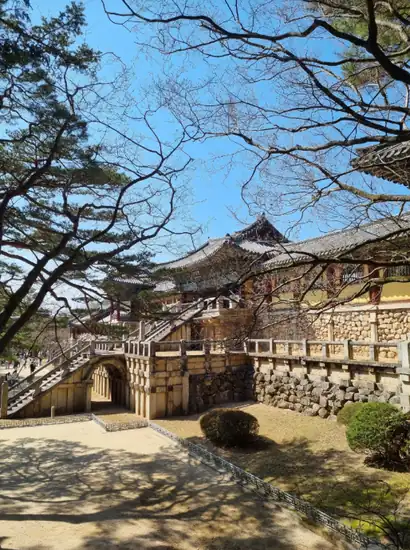
Gyeongju Bulguksa Temple is not only about seeing a temple building. It is a place where you can see major national treasures and important stone structures together. The most famous highlights are Dabotap Pagoda, Seokgatap Pagoda, and Cheongungyo and Baegungyo Bridges.
Dabotap has a more decorative and elaborate appearance, while Seokgatap looks simpler and more restrained. If you take the time to notice the difference instead of only taking photos, the visit becomes much more rewarding.
The table below lists the key heritage pieces to look for first on site.
| Heritage | Type | What to Notice |
|---|---|---|
| Dabotap Pagoda | National Treasure | Decorative design and strong visual detail |
| Seokgatap Pagoda | National Treasure | Balanced and simple proportions |
| Cheongungyo & Baegungyo Bridges | National Treasure | Symbolic stone bridges leading to the main hall |
| Yeonhwagyo & Chilbogyo Bridges | National Treasure | Stone bridge structure near Geungnakjeon Hall |
| Gilt-bronze Vairocana Buddha Seated Statue | National Treasure | Important indoor Buddhist statue |
| Gilt-bronze Amitabha Buddha Seated Statue | National Treasure | Representative Buddhist statue at Bulguksa |
Many visitors only look at Dabotap and Seokgatap, but the bridges and stairways at Gyeongju Bulguksa Temple are just as important if you want to understand the site properly.
Once you slow down in this area, it becomes clear why the temple is valued as a complete architectural work rather than just a place with famous pagodas.
5. UNESCO and Historical Importance
Gyeongju Bulguksa Temple is listed as a UNESCO World Heritage Site together with Seokguram Grotto. The site was inscribed in December 1995. UNESCO describes it as an outstanding example of 8th-century Silla Buddhist art and architecture.
Because of this, Bulguksa is not only one of Korea’s best-known temples but also a major World Heritage destination for international travelers.
The table below summarizes the key UNESCO-related points.
| Item | Details |
|---|---|
| World Heritage Name | Seokguram Grotto and Bulguksa Temple |
| Year of Inscription | 1995 |
| Paired Site | Seokguram Grotto |
| Main Value | 8th-century Silla Buddhist architecture and art |
| Current Protection | World Heritage protection, historic site status, national park area protection |
6. How Long Does a Visit Take?
One of the most common things first-time visitors overlook is how much time to allow. Gyeongju Bulguksa Temple is not extremely large, but once you slow down and look properly, it takes longer than many people expect.
A quick visit takes around 45 minutes to 1 hour. If you include photos and spend time looking at the pagodas, bridges, and stairs, 1 to 1.5 hours is more realistic. If you also plan to visit Seokguram, it is better to think of it as a half-day schedule.
The table below gives a practical time estimate for planning.
| Visit Style | Recommended Time |
|---|---|
| Quick visit for the main highlights | 45 min–1 hr |
| Standard visit with photos | 1 hr–1 hr 30 min |
| Combined with Seokguram | Half day |
| Temple Stay participation | 1 night, 2 days |
If you are doing a day trip, it is better to leave at least one full hour for Bulguksa instead of squeezing it into a short slot.
There are stairs, walking sections, and several points where people naturally stop, so the visit tends to take a little longer than expected. If the schedule is too tight, the whole visit can feel rushed.
7. Gyeongju Bulguksa Temple Stay
The clearest officially confirmed program at Bulguksa is the temple stay. There is limited public information that clearly lists all annual events in one place, but the temple stay program is consistently available and much easier to verify.
If you want more than a standard sightseeing visit, this is the most practical way to experience the temple in a different setting. The atmosphere is very different from a regular daytime visit.
The table below shows the temple stay structure based on the official program information.
| Item | Details |
|---|---|
| Program Type | 2-day, 1-night program |
| Main Program 1 | Journey into Mind |
| Main Program 2 | Cultural Experience |
| Included Activities | Temple etiquette, temple tour, temple food, evening chanting, meditation |
| Additional Activities | 108 bows, walking around the pagoda, night view |
| Accommodation Location | Separate from the main temple, about 5 minutes away by car |
| Possible Changes | May vary by season, weather, and participant numbers |
For most readers, it is better to place the Gyeongju Bulguksa Temple stay section after the core visitor information. That way, people can first understand the essential travel details, and then those who want a deeper experience can continue naturally to the next option.
8. Best Nearby Combinations
Gyeongju Bulguksa Temple is worth visiting on its own, but in real travel planning, it is most often paired with Seokguram. The two sites are linked by their shared World Heritage status, and for many visitors, the most natural flow is “Bulguksa first, then Seokguram.”
If you add Bomun Tourist Complex or central Gyeongju historic sites, it can easily fill a full day. It usually saves time to group places by route instead of visiting only one stop and moving randomly.
The table below shows simple combinations that work well for first-time visitors.
| Route | Best For | Main Benefit |
|---|---|---|
| Bulguksa only | Visitors with limited time | About 1 hour |
| Bulguksa + Seokguram | Visitors who want the signature route | Best as a half-day plan |
| Bulguksa + Bomun Tourist Complex | Families or slower-paced trips | Relatively easy movement |
| Bulguksa + central Gyeongju sites | Compressed day trip plans | Bus No. 10 helps connect stops |
“Check out other travel information”
9. Gyeongju Bulguksa Temple Summary
If this is your first visit, the most important things to confirm are the opening hours, free admission, how to get there from Seoul, and how long to stay. Bulguksa is open from 9:00 AM to 6:00 PM, and there is currently no admission fee.
From Seoul, the simplest route is to take the KTX to Singyeongju Station and connect by local transportation. The reason Bulguksa is described as both a national treasure site and a World Heritage destination becomes clear once you see the pagodas, bridges, and stone layout in person.
If you remember the table below, that is enough to plan your visit.
| Key Point | Details |
|---|---|
| Opening Hours | 09:00–18:00 |
| Exit Time | 19:00 |
| Admission Fee | Free |
| Closed Days | Open year-round |
| KTX from Seoul | About 2 hr 10 min to Singyeongju Station |
| Parking | Available, paid |
| Recommended Visit Time | 1 hr–1 hr 30 min |
| Best Nearby Pairing | Seokguram |
Gyeongju Bulguksa Temple is easy to enjoy even if you only know the basic facts before you go, but the visit becomes much better when you understand the layout in advance.
A simple way to see it is to start with the stone terraces and bridges near the entrance, then move inward slowly and spend more time around Dabotap and Seokgatap. That route feels much more natural on site.