
When exploring Jung-gu in Busan, some of the most memorable meals are not always found at the newest or trendiest restaurants. Sometimes, a meal that fits naturally into the old streets and atmosphere of downtown Busan stays with you much longer.
Part 3 of this Busan Jung-gu restaurants series brings together Donghwa Banjeom, a long-running Chinese restaurant that dates back to 1950, and Yeongyeongjae, a café known for its Korean-inspired atmosphere and moon jar dessert.
The route works especially well because it is not just about moving from one restaurant to another. You can have jajangmyeon for lunch, wander through Bosu-dong Book Street, learn a little about the city’s history, then slow down with coffee and a beautifully designed Korean dessert.
Finish the day at Yongdusan Park, and food, history, old neighborhoods, and city views all come together in one easy Jung-gu itinerary.
Table of Contents
1. What Should You Eat in Jung-gu?
When searching for Busan Jung-gu restaurants, it is easy to focus only on Nampo-dong or Jagalchi Market. But move a little farther toward Bosu-dong and Jungang-dong, and the atmosphere changes.
Donghwa Banjeom has the feel of an old Busan restaurant that has grown together with the neighborhood, while Yeongyeongjae takes traditional Korean design elements and gives them a much more modern interpretation.
| Category | Donghwa Banjeom | Yeongyeongjae |
|---|---|---|
| Type | Korean-Chinese restaurant | Café & dessert |
| Popular choices | Uni-jajang, fried rice, sweet and sour pork | Moon jar dessert, coffee |
| Best time | Lunch | Afternoon |
| Atmosphere | Old-school Busan restaurant | Traditional meets contemporary |
| Nearby attractions | Bosu-dong Book Street | Busan Modern & Contemporary History Museum, Yongdusan Park |
The two places work surprisingly well together because one is naturally a lunch stop and the other is perfect for an afternoon break.
Start at Donghwa Banjeom, walk through the old streets of Bosu-dong, then take a break at Yeongyeongjae. Add a museum and a park between them, and the day starts to feel like a proper downtown Busan trip rather than a restaurant-hopping schedule.
2. Old-School Donghwa Banjeom in Bosu-dong
If you are interested in historic Busan Jung-gu restaurants, Donghwa Banjeom is difficult to overlook.
Busan’s official tourism information introduces the restaurant as a long-established Chinese restaurant founded in 1950, later moving to its current Bosu-dong location in 1987.
The atmosphere is noticeably different from a polished modern Chinese restaurant. That slightly old-fashioned character actually suits the surrounding neighborhood very well.
Donghwa Banjeom Information
- Address: 3 Heukgyo-ro 75beon-gil, Jung-gu, Busan
- Popular dish: Uni-jajang
- Other well-known dishes: Fried rice, sweet and sour pork, nanja wanseu
- Closed: Tuesday
- Known for: A long history dating back to 1950
The first dish that tends to catch attention is uni-jajang.
Here, “uni” refers to ingredients such as meat being finely minced before being cooked with the black bean sauce. The result is a smoother sauce that coats the noodles more evenly than some standard versions of jajangmyeon.
If you enjoy old local restaurants, part of the fun comes from the space itself. The meal feels connected to the history of the neighborhood, rather than simply being another bowl of noodles.
3. Donghwa Banjeom Menu and Prices
For a first visit to this classic Busan Jung-gu restaurants stop, uni-jajang is probably the easiest place to begin.
Recent food information has listed uni-jajang at around KRW 9,500 and a small sweet and sour pork at around KRW 17,000. Prices can change, so these are best treated as a rough guide rather than guaranteed current prices.
| Menu | Approx. Price |
|---|---|
| Uni-jajang | Around KRW 9,500 |
| Fried Rice | Around KRW 8,500 |
| Small Sweet and Sour Pork | Around KRW 17,000 |
| Nanja Wanseu | Around KRW 28,000 |
If you are eating alone, uni-jajang or fried rice is the simplest choice.
For two or more people, adding sweet and sour pork or nanja wanseu makes it easier to sample several dishes at once.
Uni-jajang and fried rice are both frequently mentioned, so starting with the classics makes sense on a first visit.
Opening hours and prices may change, so checking the latest information before visiting is recommended.
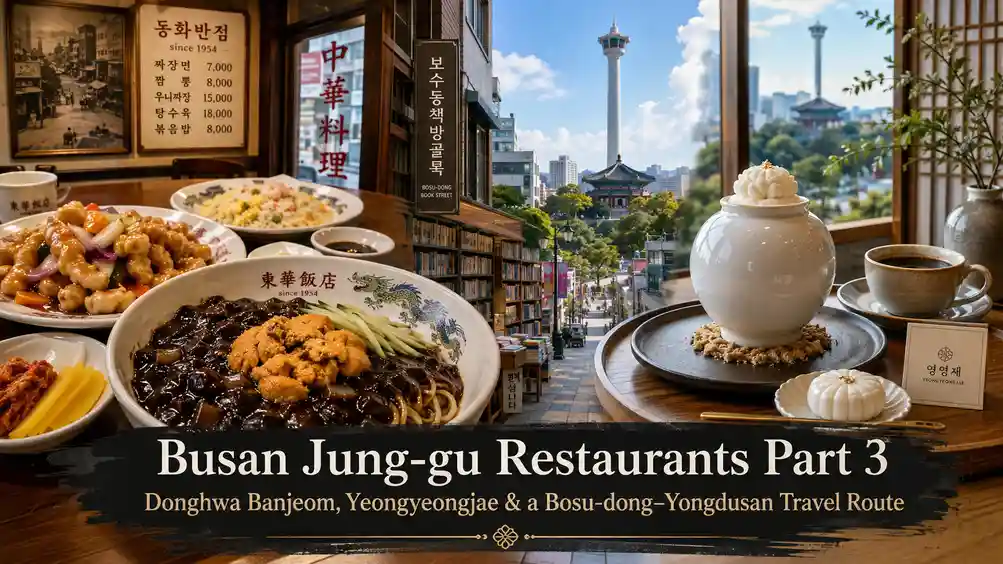
4. After Jajangmyeon, Walk Through Bosu-dong
After lunch at one of the historic Busan Jung-gu restaurants, there is no need to rush straight to another café.
The most natural next stop is Bosu-dong Book Street, an old neighborhood closely connected to Busan’s modern history.
The street is known for developing after the Korean War, when displaced people began selling used books, magazines, and other printed material in the area.
Suggested Walking Route
Donghwa Banjeom
→ Bosu-dong Book Street
→ Busan Modern & Contemporary History Museum
→ Yeongyeongjae
Bosu-dong Book Street is not the kind of attraction where you rush from one major landmark to another.
The charm comes from walking slowly between old bookstores, looking through shelves, and noticing how different each little shop feels.
From there, continuing to the Busan Modern & Contemporary History Museum makes the transition from food to the city’s history feel surprisingly natural.
The museum is currently listed as open Tuesday through Sunday from 09:00 to 18:00 with free admission. It is closed on Mondays, so keep that in mind when planning the day.
5. Yeongyeongjae Café in Jungang-dong
After walking through the old streets, another side of Busan Jung-gu restaurants and cafés appears at Yeongyeongjae.
Yeongyeongjae feels like more than just somewhere to order coffee. The space incorporates Korean-inspired design and desserts in a way that feels contemporary without losing the traditional influence behind them.
Yeongyeongjae Information
- Address: 6 Jungang-daero 29beon-gil, Jung-gu, Busan
- Opening hours: 08:30–21:30
- Last order: 21:00
- Signature choices: Coffee and moon jar desserts
- Style: Modern café inspired by Korean aesthetics
The most eye-catching item is the moon jar dessert.
Its round white shape is inspired by the iconic Korean white porcelain moon jar, so even before tasting it, the dessert looks completely different from a typical slice of cake.
It is photogenic, but the appeal is not limited to appearance. Different fillings and textures are layered inside, which makes breaking into the smooth outer shell part of the experience.
For international travelers, it is also an easy introduction to an element of traditional Korean design in a very approachable form.
6. From a Moon Jar Dessert to Yongdusan Park
Stopping at Yeongyeongjae does not have to be the end of your Busan Jung-gu restaurants itinerary.
After coffee and dessert, continue toward Yongdusan Park. The route also takes you through the Nampo-dong and Gwangbok-dong area, making it easy to experience a little more of central Busan along the way.
Afternoon Route
Yeongyeongjae
→ Gwangbok-dong
→ Yongdusan Park
→ Busan Tower
Yongdusan Park is one of the best-known urban parks in Jung-gu and makes a comfortable place to slow down after walking through the city.
Continue to Busan Tower, and you can look out over Busan Port and the older downtown districts from above.
Arriving around sunset works especially well. A Jung-gu trip that began with lunch can finish with evening views over the city.
Current tourism information lists Busan Tower hours as 10:00–22:00, with ticket sales ending at 21:30. It is still a good idea to check the latest opening hours on the day of your visit.
7. A Full-Day Jung-gu Food and Travel Route
The easiest way to enjoy Part 3 of this Busan Jung-gu restaurants series is to begin at Donghwa Banjeom, slow down around Bosu-dong, take a café break at Yeongyeongjae, and finish the day around Yongdusan Park.
Lunch
Donghwa Banjeom → Uni-jajang, fried rice, sweet and sour pork
Afternoon Walk
Bosu-dong Book Street → Busan Modern & Contemporary History Museum
Café Break
Yeongyeongjae → Coffee and moon jar dessert
Late Afternoon or Evening
Gwangbok-dong → Yongdusan Park → Busan Tower
| Travel Experience | Recommended Stop |
|---|---|
| Historic Busan restaurant | Donghwa Banjeom |
| Old neighborhood walk | Bosu-dong Book Street |
| Busan history | Busan Modern & Contemporary History Museum |
| Korean-inspired dessert | Yeongyeongjae |
| Downtown views & night scenery | Yongdusan Park & Busan Tower |
One of the advantages of Jung-gu is that many attractions are relatively close together.
Instead of filling the schedule with too many stops, the rhythm of lunch → old streets → history → café → city views gives you a nice balance between walking and resting.
More than anything, this route is not just about visiting two places to eat. It gives you a chance to experience the atmosphere of old downtown Busan along the way.
FAQ
1. What should I order first at Donghwa Banjeom?
Uni-jajang is the easiest place to start. It offers a slightly different texture from ordinary jajangmyeon, and it is one of the dishes most closely associated with the restaurant.
If you are visiting with someone else, adding sweet and sour pork or nanja wanseu makes it easier to try several dishes. Fried rice is also a good option if you prefer rice over noodles.
2. What is Yeongyeongjae best known for?
The moon jar dessert is one of the most distinctive choices.
Its design is inspired by traditional Korean white porcelain moon jars, making it especially interesting for travelers who want something a little different from a standard café dessert.
It also pairs naturally with coffee and works well as an afternoon break after exploring Jung-gu.
3. Can I visit Bosu-dong and Yongdusan Park on the same day?
Yes. The route is very manageable.
Have lunch at Donghwa Banjeom, explore Bosu-dong Book Street and the history museum, take a break at Yeongyeongjae, and then continue toward Yongdusan Park.
Because the itinerary stays within Jung-gu, you do not have to spend much of the day traveling across Busan.
Quick Summary
Part 3 of this Busan Jung-gu restaurants series is about more than simply finding two popular places to eat.
Donghwa Banjeom
→ A long-running Busan Chinese restaurant dating back to 1950
→ Uni-jajang, fried rice, and sweet and sour pork
→ Easy to combine with Bosu-dong Book Street
Yeongyeongjae
→ Korean-inspired café in Jungang-dong
→ Coffee and distinctive moon jar desserts
→ Easy to combine with the history museum and Yongdusan Park
Suggested Route
Donghwa Banjeom
→ Bosu-dong Book Street
→ Busan Modern & Contemporary History Museum
→ Yeongyeongjae
→ Yongdusan Park & Busan Tower
Start with a bowl of jajangmyeon, wander through old bookstores, slow down with a Korean-inspired dessert, and end the day with views over downtown Busan.
For travelers who want to experience not only Busan’s food but also the character of its old downtown neighborhoods, this makes a wonderfully balanced day in Jung-gu.