
Busan Station is often treated as nothing more than a transportation hub, but just a short walk beyond the station reveals a very different side of the city. Old hillside neighborhoods, narrow streets, historic walking routes, and long-running local restaurants are all packed into this part of Busan.
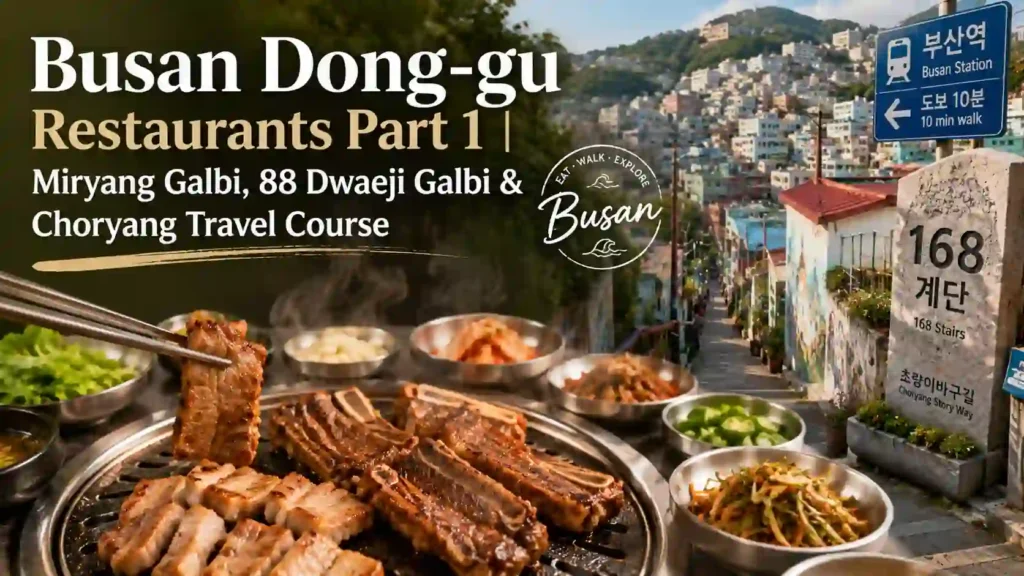
For travelers searching for Busan Dong-gu restaurants, Miryang Galbi in Choryang and 88 Dwaeji Galbi in Sujeong-dong offer two different ways to experience Korean pork BBQ.
Add Choryang Ibagu-gil, the famous 168 Stairs, and Busan’s hillside roads to the itinerary, and a simple meal can easily turn into a memorable half-day trip.
Although both restaurants specialize in grilled pork, their meat, seasoning, atmosphere, and surrounding neighborhoods are quite different.
Table of Contents
1. Start Your Dong-gu Food Trip at Busan Station
Busan Station may look like a place to simply arrive, catch a train, and leave, but the neighborhoods behind it tell another story.
Walk toward Choryang and the modern cityscape quickly gives way to steep streets, older buildings, hillside homes, and local restaurants that have been part of the neighborhood for years.
This makes Busan Dong-gu restaurants particularly interesting for travelers who want more than famous tourist districts such as Haeundae or Gwangalli.
| Travel Point | What to Expect |
|---|---|
| Best starting point | Busan Station |
| Local food | Pork ribs, fresh pork ribs, marinated pork |
| Nearby attractions | Choryang Ibagu-gil, 168 Stairs |
| Atmosphere | Old Busan, hillside neighborhoods, local food |
| Recommended time | Lunch to afternoon or afternoon to dinner |
One of the biggest advantages of this area is that local food, history, and neighborhood scenery can all be experienced without traveling far from Busan Station.
For first-time visitors to Busan, it also offers a side of the city that feels very different from the beaches and skyscrapers along the coast.
Leaving some extra time before or after the meal makes it much easier to explore Choryang at a relaxed pace.
2. Miryang Galbi in Choryang
Miryang Galbi is located on Choryang-ro in Busan’s Dong-gu district, making it convenient to combine with a visit to Busan Station and Choryang.
Among Busan Dong-gu restaurants, it stands out because visitors can try both fresh, unseasoned pork ribs and Korean-style marinated pork ribs.
Official Busan tourism information lists saenggalbi and dwaeji galbi among its signature dishes.
| Information | Details |
|---|---|
| Restaurant | Miryang Galbi |
| Address | 17-5 Choryang-ro, Dong-gu, Busan |
| Signature dishes | Fresh pork ribs, marinated pork ribs |
| Phone | 051-466-4546 |
| Listed hours | 11:30 a.m.–9:30 p.m. |
| Listed closing day | Second Tuesday of the month |
| Best combined with | Choryang and Busan Station sightseeing |
For travelers trying Korean pork BBQ for the first time, knowing the difference between the two main styles makes ordering much easier.
Saenggalbi, or fresh pork ribs, is served without a strong marinade, allowing the natural flavor of the pork to stand out.
Dwaeji galbi, on the other hand, is typically marinated in a sweet and savory Korean-style sauce before being grilled.
Trying both can be a good way to experience how much a marinade changes the flavor of Korean BBQ.
For an English menu or travel guide, the terms can be explained simply as:
- Saenggalbi: fresh or unmarinated pork ribs
- Dwaeji galbi: marinated pork ribs
Prices, opening hours, and closing days can change, so checking the latest information shortly before visiting is recommended.
3. 88 Dwaeji Galbi in Sujeong-dong
While Miryang Galbi lets visitors compare fresh and marinated pork ribs, 88 Dwaeji Galbi offers a different kind of experience.
This Busan Dong-gu restaurant is located in Sujeong-dong and is known for Korean-style marinated pork grilled over charcoal.
Interestingly, despite the restaurant’s name, official tourism information lists marinated pork neck as its main specialty.
| Information | Details |
|---|---|
| Restaurant | 88 Dwaeji Galbi |
| Address | 101-1 Gogan-ro, Dong-gu, Busan |
| Signature dish | Marinated pork neck |
| Phone | 051-468-3065 |
| Listed hours | 12:00 p.m.–10:30 p.m. |
| Style | Charcoal-grilled marinated pork |
| Atmosphere | Local neighborhood BBQ restaurant |
The combination of sweet and savory marinade with charcoal grilling gives the meat a distinctly Korean BBQ character.
Recent visitor information also mentions that staff may help grill the meat, which can make the meal easier for travelers experiencing Korean BBQ for the first time.
Rice is often paired with sirak-guk, a simple Korean soup commonly made with dried radish greens. It is the kind of everyday local dish that may feel unfamiliar to international visitors but adds another layer to the experience.
Rather than a polished tourist restaurant, 88 Dwaeji Galbi is better suited to travelers interested in a more local neighborhood dining atmosphere.
Because online sources sometimes show different business hours and closing days, checking the latest schedule before visiting
4. Miryang Galbi or 88 Dwaeji Galbi?
At first glance, the two restaurants may seem similar because both specialize in grilled pork.
The experience, however, is quite different.
When choosing between these Busan Dong-gu restaurants, it is easier to think about what kind of Korean BBQ experience sounds more appealing rather than simply asking which restaurant is better.
| Comparison | Miryang Galbi | 88 Dwaeji Galbi |
|---|---|---|
| Neighborhood | Choryang | Sujeong-dong |
| Main style | Fresh & marinated pork ribs | Marinated pork neck |
| Flavor | Mild or marinated | Sweet-savory charcoal BBQ |
| Best feature | Compare two pork styles | Local charcoal BBQ experience |
| Nearby travel | Choryang, Busan Station | Hillside neighborhoods |
| Best for | First-time visitors | Travelers seeking a local atmosphere |
Choose Miryang Galbi if trying both unseasoned pork and Korean marinated pork sounds appealing.
Choose 88 Dwaeji Galbi for marinated pork cooked over charcoal in a more local neighborhood setting.
There is no need to think of them as two versions of the same restaurant. Visiting them for different reasons makes it easier to discover the variety within Busan pork BBQ.
5. Choryang Ibagu-gil and the 168 Stairs
A meal in Choryang becomes much more interesting when it is combined with a walk along Choryang Ibagu-gil.
Adding this route to a Busan Dong-gu restaurants itinerary turns a restaurant visit into a short journey through Busan’s modern history.
The walking route connects places such as the former Baekje Hospital, Choryang Church, old neighborhood streets, and the famous 168 Stairs.
| Stop | What Makes It Interesting |
|---|---|
| Busan Station | Convenient starting point |
| Former Baekje Hospital | A glimpse of old Choryang |
| Choryang Church | Historic stop along Ibagu-gil |
| 168 Stairs | Symbol of Busan’s hillside neighborhoods |
| Choryang 168 Sky Road | Inclined elevator |
| Hillside viewpoints | Views toward the port and old city |
The 168 Stairs are especially meaningful because they reflect the history of Busan’s hillside communities, many of which expanded rapidly when refugees settled in the city during and after the Korean War.
There is also one important update for international travelers.
The old monorail shown in many older travel blogs and videos is no longer operating.
It was replaced by an inclined elevator, now known as the Choryang 168 Stairs Sky Road, which began operating in 2025.
This is worth knowing because older English-language travel information may still refer to the former monorail.
6. Turn It Into a Half-Day Travel Course
Travelers with a little more time can extend a Busan Dong-gu restaurants trip beyond Choryang and explore the hillside roads that give this part of Busan its distinctive character.
The Mangyang-ro Hillside Road Exhibition Hall introduces the history of these communities and the lives of people who settled along Busan’s steep slopes.
Course A | Best for First-Time Visitors
Busan Station → Choryang Ibagu-gil → 168 Stairs → Miryang Galbi
This is the easiest course to follow.
Busan Station provides a convenient starting point, the walking route introduces the history of Choryang, and the day finishes naturally with Korean pork BBQ.
For international travelers, it works well as a Busan Station Half-Day Walking & Food Course.
Course B | A More Local Side of Busan
Mangyang-ro Hillside Road → Neighborhood Viewpoints → 88 Dwaeji Galbi
This route focuses more on Busan’s hillside neighborhoods before ending with a local BBQ meal in Sujeong-dong.
Because some streets are quite steep, it is more comfortable to combine walking with a local bus or taxi instead of trying to cover the entire route on foot.
If There Is More Time
Travelers interested in history can also look into the Busanpo Open Port Road, which connects several historical sites related to Busan’s modern development.
It is better suited to a longer historical walking itinerary than a quick restaurant visit.
7. Useful Tips for International Travelers
When combining sightseeing with Busan Dong-gu restaurants, planning the order of the day is more useful than simply saving restaurant locations.
Choryang Ibagu-gil and the 168 Stairs area include steep slopes, so the walk can feel longer than expected during hot summer weather or on rainy days.
Saving both the Korean restaurant name and the full address can also make taking a taxi much easier.
| Situation | Recommended Choice |
|---|---|
| Just arrived at Busan Station | Start with Choryang |
| Prefer less walking | Use buses or taxis on hillside roads |
| Want fresh pork ribs | Miryang Galbi |
| Want marinated charcoal BBQ | 88 Dwaeji Galbi |
| Short itinerary | Busan Station → Ibagu-gil → Miryang Galbi |
| Half-day itinerary | Add the hillside road area |
Korean BBQ restaurants may also have minimum-order requirements that vary by restaurant.
Checking the menu before ordering can prevent confusion, especially when dining alone or as a small group.
Most importantly, restaurant prices, opening hours, and closing days can change, so checking current information on the day of the visit is always a good idea.
FAQ
Is Miryang Galbi close enough to combine with Choryang Ibagu-gil?
Yes. Choryang Ibagu-gil begins near the Busan Station area, making it easy to combine sightseeing and a meal in the same itinerary.
Because the route includes hills and stairs, comfortable shoes are recommended.
Which restaurant is better for a first Korean BBQ experience?
Miryang Galbi is a good choice for travelers who want to compare fresh pork ribs with Korean-style marinated pork ribs.
88 Dwaeji Galbi may appeal more to travelers looking for charcoal-grilled marinated pork and a neighborhood-style Korean BBQ experience.
Is the 168 Stairs monorail still operating?
No.
The monorail shown in older travel guides is no longer in operation. It has been replaced by an inclined elevator known as the Choryang 168 Stairs Sky Road, which began operating in 2025.
Quick Summary
A search for Busan Dong-gu restaurants can lead to much more than just a meal.
Miryang Galbi offers the chance to compare fresh pork ribs with Korean-style marinated pork ribs, while 88 Dwaeji Galbi focuses on marinated pork grilled over charcoal in a more local neighborhood setting.
Nearby, Choryang Ibagu-gil and the 168 Stairs add history, hillside scenery, and a glimpse into everyday Busan beyond the city’s famous beaches.
Recommended Route
Busan Station → Choryang Ibagu-gil → 168 Stairs → Miryang Galbi
Alternative Local Route
Mangyang-ro Hillside Road → Local Viewpoints → 88 Dwaeji Galbi
For travelers searching for Korean BBQ near Busan Station, combining food with the surrounding neighborhoods makes this part of Busan much more rewarding.